date_range
Monday 02 Feb 2026


 LOCAL EDITION
close
 LOCAL EDITION


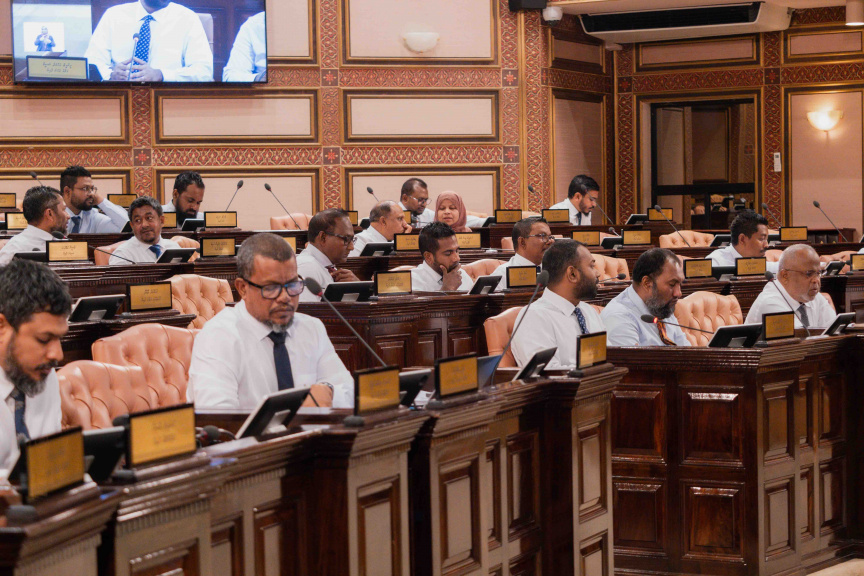
Lawmakers captured during a parliamentary sitting: The Parliament greenlights death penalty for drug traffickers. (Photo/People's Majlis)
The Parliament, on Wednesday, has passed the government-backed amendment to Drugs Act to introduce death penalty for individuals convicted of trafficking more than 500 grams of drugs into the Maldives.
The Appendix 1 of the government-backed bill sponsored by ruling PNC’s Gan MP Yoosuf Nasheed introduces death penalty for individuals convicted of trafficking more than 500 grams of drugs into the Maldives. However, the death penalty can only be implemented if upheld unanimously by the Supreme Court bench hearing the case.
The Appendix 1 of the bill also outlines prohibited drugs and items containing these substances.
Meanwhile, Appendix 2 outlines drugs which can be used for medical purposes and products that a manufactured using these substances.
The Appendix 3 sets forth resources including chemicals and equipment that can be used to manufacture drugs.
The punishment for drug trafficking under the current Drugs Act is life imprisonment, along with a fine ranging from MVR 10 million to MVR 100,000 million.
According to the bill, the proposed amendment aims to strengthen the ability of law enforcement agencies to tackle drug-related offenses, including trafficking, in response to the rising number of such crimes.
It also seeks to overhaul the rehabilitation system established under the current Drugs Act to provide more comprehensive treatment for drug addicts and support their reintegration into society.
Some of the main provisions in the bill:
In this regard, Maldives Customs Service can now detain and search Customs officers without a court order when there is reasonable suspicion that the officer has committed, or might commit, an offense under the Drug Act while performing their duties.
Similarly, Maldives Police Service has also been granted expanded powers.
In addition, the bill requires briefing the President on drug-related crimes, drug-related violence, and health issues arising from drug use. It also outlines the identification of national policies to address these issues, proposed amendments to existing policies, and guidance to the President on implementing such changes.