date_range
Saturday 07 Feb 2026


 LOCAL EDITION
close
 LOCAL EDITION


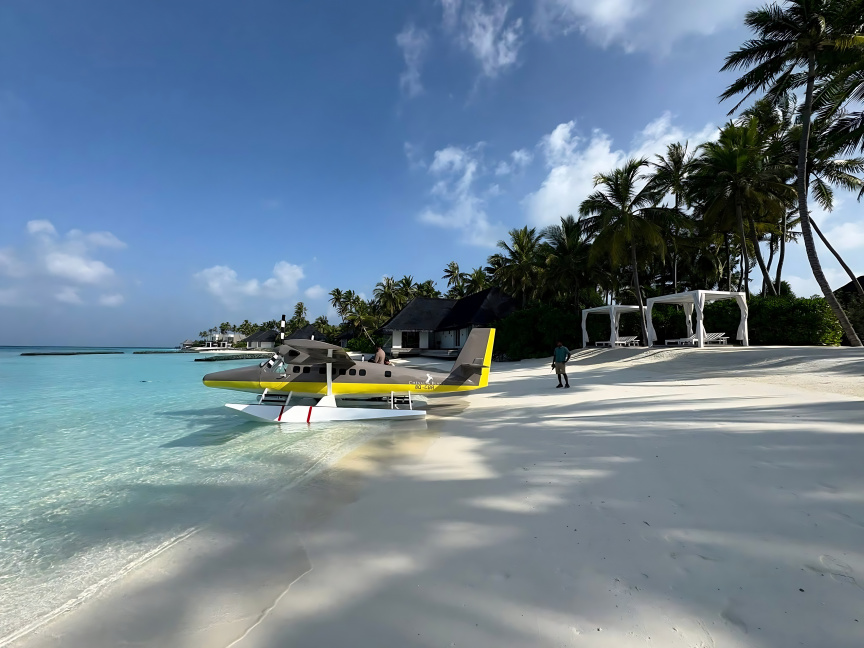
The seaplane replica made by 43‑year‑old Maldivian, Mohamed Majid, is being taken to sea for a little drive, using a seabob. (Facebook Photo/Hussain Niyaz)
A Maldivian-built seaplane has captured nationwide attention, leaving many stunned by its detail and craftsmanship after photos of it went viral on social media.
More than 200 people have liked the images and over 100 have shared them, most of them reacting with the same mix of surprise and admiration.
Behind the work is 43‑year‑old Mohamed Majid, a Maldivian craftsman with decades of hands‑on experience in carpentry and boatbuilding. Majid, who works at Cheval Blanc Randheli resort, comes from a family of carpenters; his father and grandfather were both in the trade. The family, he says, has always been made up of serious, skilled workers, and that legacy shaped him.
From a young age, Majid was drawn to making things that were technical and precise. That curiosity never faded. Even now, he still creates various handcrafted items and sells them to resort guests.
For years, he had wanted to build a resort seaplane as a life‑size replica of the original aircraft. After 11 years working at the resort, that long‑held idea finally turned into reality when management proposed an activity project, and Majid seized the opportunity.

Colleagues at the resort also saw the idea of a seaplane as something special. People often talked about building one, but it had never progressed beyond conversation. This time, when management raised it, Majid immediately said yes, with full confidence.
“They knew what I could do,” he said. “If I said yes, they didn’t need to ask many questions. I knew I could handle everything with the materials we had.”
Majid began where any serious build starts: with a drawing. He first drafted the seaplane to scale so he could translate the idea into precise measurements and proportions. For him, the ability to draw is part of being a modern carpenter.
“If a carpenter doesn’t have drawing skills and that kind of training, you can’t do this kind of work properly today,” he said.
Because he could sketch and design, the planning stage felt natural. The next challenge was deciding how to build a seaplane that would actually float and remain stable on the water. With buoyancy and balance in mind, he chose to construct the body from fibreglass.
He didn’t need to ask anyone else for technical advice. Majid already designs speedboats and other vessels, and understands weight, balance, and materials. His experience in marine construction led him to fibreglass as the right choice.
Once the drawing was complete, he refined the design further using photos of the resort’s actual seaplane as reference. Majid always aims to do his work to the highest standard, and from the very beginning he hoped this project would go viral and be widely appreciated.
After finalising the drawings, he built a timber mould to shape the seaplane. Over that, he laid and formed the fibreglass shell, smoothing the exterior and shaping it to match the original as closely as possible. The inside was then cut and hollowed out so the structure would remain light and behave correctly in the water.
“The inside has to be empty,” Majid explained. “Otherwise the weight and the movement of the plane won’t be right. I used thin material, but it still has to be strong.”
Once the fibreglass shell was complete, the internal timber mould was removed and is no longer inside the structure. The remaining sections of the seaplane were built as separate parts. These were fabricated at the resort, then transported to another island and assembled in a factory setting.
The seaplane does not yet have an engine, but it has been designed so that one can be installed in future.
“It’s being talked about a lot because of the quality,” Majid said. “Management also wanted it to be driveable.”

What stunned many people was how closely Majid’s seaplane matches the original aircraft. He completed the project in six months, and the level of finish is such that, side by side with the resort’s actual plane, it is hard to tell which is which. The replica is strikingly beautiful and convincing.
Even without an engine, the seaplane has already been taken out on the water. Resort staff used a seabob, a small powered device guests normally use for snorkelling and diving, to tow the seaplane while someone held on.
For Majid, the project has been deeply satisfying. Many did not believe it could be completed to this standard. His work forced them to change their minds.
“I’m very happy I was able to do something like this as a Maldivian,” he said. “I think it’s something to be proud of.”
Majid believes that projects like this begin with confidence, the belief that you can do it. The praise he has received has delighted him and, after many years in the field, given him a sense of fulfilment he had long been searching for.