date_range
Saturday 07 Feb 2026


 LOCAL EDITION
close
 LOCAL EDITION


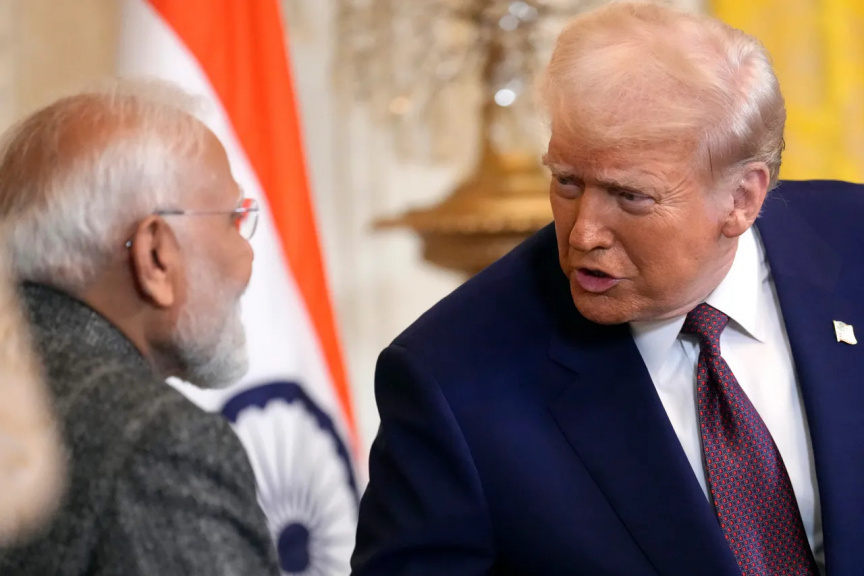
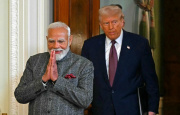
On Friday, Trump signed executive order rescinding a punitive 25% duty on all imports from India over its purchases of Russian oil. (Photo/AP)
The United States and India have released a framework for an interim trade agreement, saying it reaffirms their commitment to negotiations aimed at a broader bilateral trade deal.
In a joint statement issued on Friday, the two countries said they would "promptly implement" the framework and work towards finalising the interim agreement, with the goal of concluding a mutually beneficial Bilateral Trade Agreement.
"The United States and India will promptly implement this framework and work towards finalising the Interim Agreement with a view to concluding a mutually beneficial BTA consistent with the roadmap agreed in the Terms of Reference," the statement said.
The move has followed US President Donald Trump's announcement earlier this week of a deal to reduce US tariffs on Indian goods to 18 percent from 50 percent.
The arrangement was tied to India halting purchases of Russian oil and lowering certain trade barriers.
Tariff rollback
Trump said the understanding was reached after a call with Indian Prime Minister Narendra Modi and added that India will not buy Russian oil and would instead purchase oil from the US and potentially from Venezuela.
Trump said Modi also committed to buying up to $500 billion worth of US products — energy, technology, aircraft, and some agriculture — over the coming years.
On Friday, Trump also signed an executive order rescinding a punitive 25 percent tariff on all imports from India that had been imposed over New Delhi's purchases of Russian oil.
The US and India said the interim framework reaffirms their commitment to the broader Bilateral Trade Agreement negotiations and aims to support more resilient supply chains.
"The Interim Agreement between the United States and India will represent a historic milestone in our countries' partnership, demonstrating a common commitment to reciprocal and balanced trade based on mutual interests and concrete outcomes," the joint statement said.
According to the terms outlined, India will lower or eliminate tariffs on US industrial goods and a wide range of agricultural products, "including dried distillers’ grains (DDGs), red sorghum for animal feed, tree nuts, fresh and processed fruit, soybean oil, wine and spirits, and additional products."
The United States will separately lower its reciprocal tariff to 18 percent and remove duties on Indian aircraft and associated parts.
India has also agreed to address long-standing barriers affecting trade in US medical devices, the statement said.
India has also agreed to address long-standing non-tariff barriers to the trade in US food and agricultural products.
It said, "India intends to purchase $500 billion of U.S. energy products, aircraft and aircraft parts, precious metals, technology products, and coking coal over the next five years."
Indian Trade Minister Piyush Goyal said on Thursday that Washington and New Delhi expect to sign a formal trade deal in March.
Opening agriculture sector to US?
US President Trump, US Trade Representative Jamieson Greer, and Agriculture Secretary Brooke Rollins have claimed broader opening of India's "massive" farm market, zero tariffs on a "vast" set of US agricultural goods, and increased US exports to reduce their trade deficit.
Indian government officials have repeatedly emphasised that agriculture and dairy sectors are fully protected.
Indian opposition Congress has called for clarity on the deal's contents, with party president Mallikarjun Kharge warning of "massive farm protests" similar to those against the 2020-21 farm laws, which were withdrawn by Modi government, if agriculture sector is opened for US products.
Congress leaders have alleged hidden concessions by the Modi government regarding US agricultural imports.
They claim this could potentially flood markets with cheap and subsidised US produce, causing real damage to farmers and the dairy industry once the details are revealed.
Modi government insists farmers are protected, but Congress portrays it as a sell-out risking rural livelihoods.
___
Source: TRT