date_range
Monday 09 Feb 2026


 LOCAL EDITION
close
 LOCAL EDITION


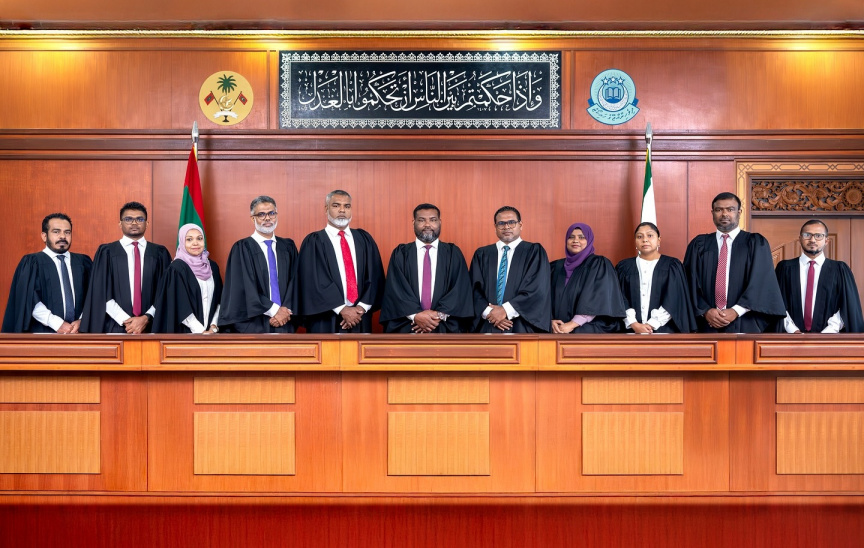
High Court judges. (Photo/High Court of Maldives)
The Supreme Court has amended the judicial dress‑code regulation to make the cleaning and upkeep of judges’ gowns a responsibility of the courts, rather than the judges themselves.
The change was issued on Monday as the second amendment to the 2024 dress‑code rule, which first introduced mandatory gowns for lower‑court judges. Until last year, only Supreme Court and High Court judges wore gowns, while lower‑court judges appeared in black or dark‑blue formal suits.
When the gown requirement came into force in 2024, judges were responsible for maintaining and dry‑cleaning their own attire. With the latest amendment, the Supreme Court has shifted that responsibility to the courts, formalising gown maintenance as an institutional duty rather than an individual one.
Judicial attire carries symbolic weight in the Maldives, reflecting both the independence of the judiciary and elements of Maldivian and Islamic heritage. The regulation states that gowns must follow the model designed by the Department of Judicial Administration (DJA). The Supreme Court’s own gown features a distinctive design inspired by Maldivian history, including a facing pattern based on the stonework of Male’s Hukuru Miskiy.

By taking over the upkeep of gowns, the Supreme Court signals an effort to standardise judicial presentation across all courts and ensure that the symbolism attached to the attire is preserved consistently.