date_range
Monday 09 Feb 2026


 LOCAL EDITION
close
 LOCAL EDITION


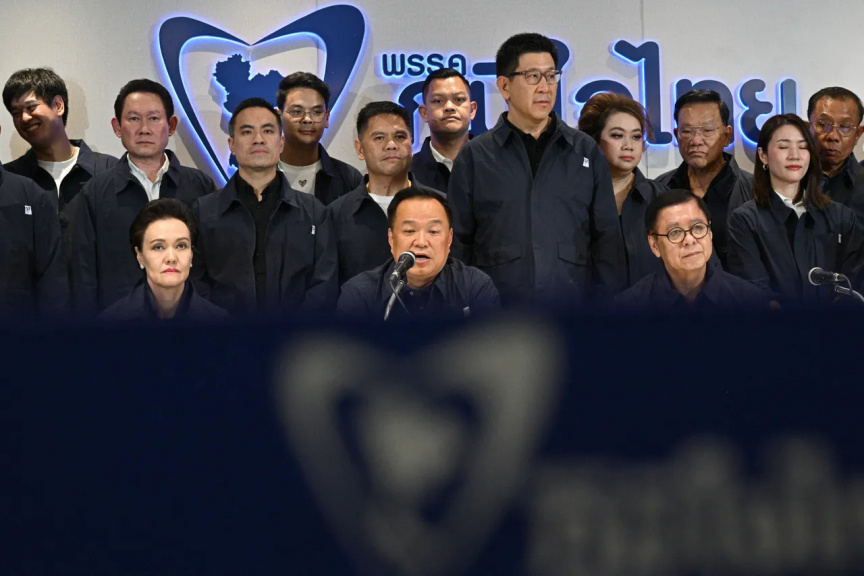
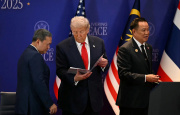
Anutin Charnvirakul (front C) speaks during a press conference while awaiting final results in Thailand's general election, February 8, 2026. (Photo/AFP)
Thailand's caretaker premier, Anutin Charnvirakul, was preparing for coalition talks on Monday after a stunning election victory for his conservative Bhumjaithai Party.
Bhumjaithai was forecast by Channel 3 to have won almost 200 seats in Sunday's vote, well ahead of others but short of an outright majority in the 500-member lower house.
The progressive People's Party trailed at a little above 100 seats, while jailed former prime minister Thaksin Shinawatra's Pheu Thai party came in third.
Pheu Thai is seen as a likely coalition partner for Anutin, as they were allies until Bhumjaithai pulled out over a scandal linked to the Cambodia border dispute.
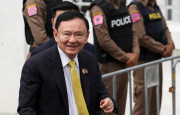
Thaksin is serving a one-year prison sentence for corruption in office, but many observers expect him to be released earlier than scheduled, alongside a political agreement.
Anutin, who took office in September, declined to be drawn on Sunday on potential coalition talks, noting the election results remained unofficial.
"We will wait until its more clear, and every party has to meet their executive board to discuss the position," he said.
Political analyst Napon Jatusripitak expected Bhumjaithai to "move quickly" to form a government in which its interests would prevail.
"Given the seat distribution, Bhumjaithai is likely to lead a government in which its influence predominates and weighs most decisively in shaping both policy direction and implementation," he said.
Cambodia conflict
The Southeast Asian nation's next administration will need to tackle anaemic economic growth, with its vital tourism industry yet to rebound to pre-Covid highs, and manage fallout over multibillion-dollar cyberscam networks operating from the region.
Perhaps most pressing is the Cambodia dispute, which erupted into open fighting in July and December, killing scores of people on both sides and displacing around a million altogether.
The conflict was top of mind for many voters, with analysts saying a wave of nationalism propelled Anutin to victory.
"Thailand will move like it moved in the past three months. We will see nationalism, a strong position on Cambodia and economic policies. Nothing changes," said Virot Ali, politics lecturer at Thammasat University.
Soon after becoming premier - following the removal of two predecessors from Pheu Thai by the courts - Anutin authorised the armed forces to take whatever action they saw fit on the border.
Thailand's military took control of several disputed areas in the latest fighting in December, and a fragile ceasefire remains in place.
"Once I became prime minister, everything we once lost, it has come back to be ours again," Anutin said at a rally in the Sisaket border province last week.
Paul Chambers, an associate senior fellow at ISEAS-Yusof Ishak Institute in Singapore, cautioned that Anutin's victory "will allow the military to become even more autonomous of civilian control".
___
Source: TRT